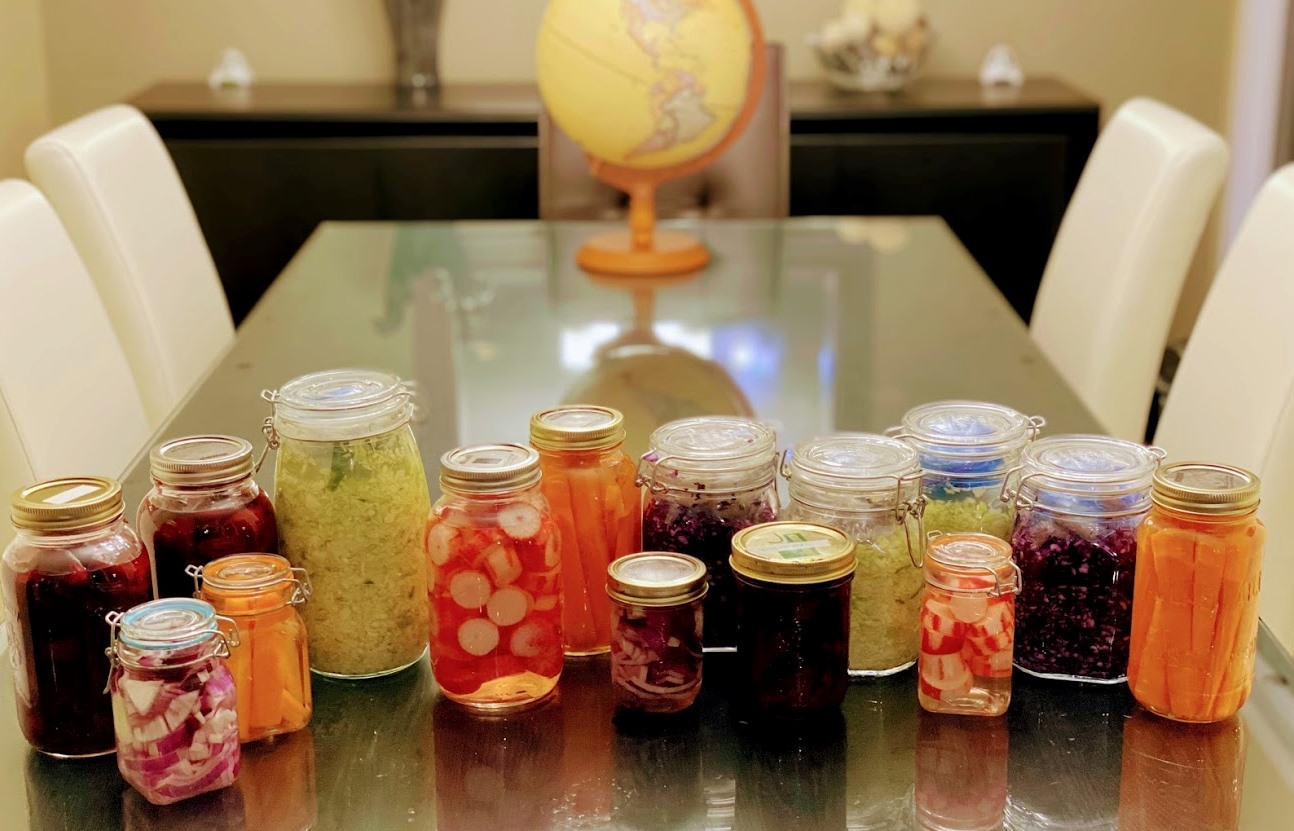
On a cold november afternoon, we spend time together in the kitchen pickling food.
I really do find simple happiness in my kitchen…
We prepared pickled beets, carrots, red onions, pink daikon radish and sauerkraut.
Here are my simple basic recipes.
First, wash your hands and use very clean / oven sterilized jars.
For pickling, pick a vegetable you love, clean and cut it. Prepare a solution of water, vinegar, salt and sugar. Most recipe will prescribe specific quantities of vinegar, salt and water but I say adjust the quantities to your preferences. In a 1L of pickling solution, the acidity I like is about 1/3 to 1/4 regular white vinegar. Many recipe ask for 1/2 vinegar and I tried it and found it to be too strong. The sweetness I like is about 1/2 3/4 cup sugar. It seems a lot but to get the nice sweet-acidic balance that my taste buds appreciate, that what I feel it takes. I add 2 teaspoon of salt. We all have preferences, I suggest you play with the quantities, you’ll eventually find your own recipe. Remember that the level of sweet-acid-saltiness you like will be diluted in the vegetable you pickle. Go for a solution that taste about one fifth stronger in intensity than what you want so that your pickled vegetable will be just perfect for you. Refrigerate your jars.
For sauerkraut, cut you cabbage as you like it. Weigh it. Add 2% salt in weight, make sure you mix it in well. Compress the cabbage in your jar. Water will be drawn out by the added salt. There must be no air for the fermentation process to take place optimally. The cabbage must be entirely submerged in it’s own salty water. You can buy sauerkraut kits on amazon that include a jar and fermentation glass weights. I use a regular jar with marbles in a ziplock bag as weight to achieve the same result. Ferment at room temperature away from sunlight for about 7 days then put in the refrigerator. Some ferment longer but I find it’s just not necessary. When you open your fermented food jars, look and smell before eating. If you see mold, throw it away. If it smells weird, throw it away. Fermented food have a distinct smell that is recognizable and very different from rotten food.
If you used clean jars, the right amount of salt and made sure your cabbage in submerged in it’s own salty juice, the procedure of fermentation is safe. Warning, do not try to lower salt content as it is part of the conservation process.
I do not want to be responsible for any health issues that could be associated with fermentation at home so I have to recommend that you read more on how to safely ferment at home. Look up fermentation safety on Google and educate yourself. This resource is a good start: https://www.bcfoodprotection.ca/…/Lorraine%20McIntyre…
Original post Facebook, November 2020
 Martin Pham Dinh